For museums, universities, youth programs, schools, and sponsors

Build a science world learners can reason through.

Lumin Learning turns scientific relationships into playable systems. We are looking for a small number of institutions willing to shape, review, fund, or host the next expedition—without pretending a prototype is already a proven school platform.

Four clear decisions

Choose the scope before choosing the spectacle.

Each path is deliberately bounded. The aim is to solve one real learning or public-engagement problem, produce something testable, and learn enough to justify—or reject—the next investment.

01

Paid discovery

Define the learner, concept, scientific model, game mechanic, review roles, data boundaries, pilot design, and fixed next-stage scope before anyone commits to a full build.

Best for: institutions with a problem but no validated game concept
02

Custom expedition

Design and build a focused science experience with partner expertise, facilitator material, technical validation, supervised testing, and an honest findings report.

Best for: museums, research centers, and education programs
03

Sponsored public experience

Fund public access to a rigorously reviewed expedition. Attribution is visible; learner targeting, learner-data access, and sponsor control over evidence are not part of the deal.

Best for: foundations and science-aligned community investment
04

Supervised pilot

Use one existing experience with a small cohort, a named facilitator, predefined usability and transfer measures, implementation support, and a candid report.

Best for: camps, clubs, classrooms, libraries, and youth programs
What exists now

Working systems, still under construction.

The current browser prototypes explore several forms of simulation-first learning. They provide a concrete starting point for fit conversations; they are not presented as completed, certified, or independently validated products.

Nori Colony science survival prototype
Living systems

Nori Colony: Living Systems

Save a colony from starvation and cold before winter by diagnosing failing crops, restoring its plant life, and turning biology and chemistry into food and fuel.

Orbital physics sandbox prototype
Physics and astronomy

Gravity Lab

Learners launch, observe, and revise orbital systems. Trajectory, force, momentum, and escape behavior are the play—not explanatory wallpaper.

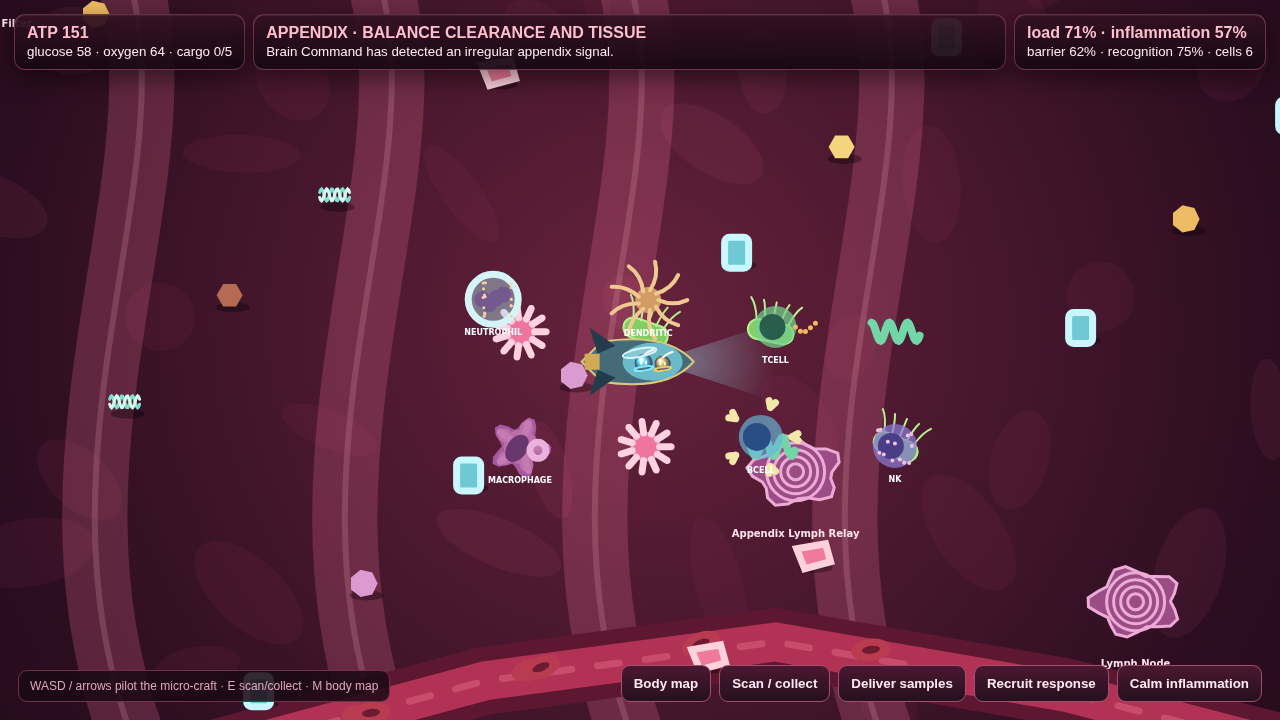
Immune-system expedition prototype
Biology and systems strategy

Immune Defense

Pathogen classification determines which defenses work. A learner who understands the biology builds a stronger strategy because the knowledge changes combat.

Evidence and boundaries

Trust starts with the claims we refuse to fake.

An early partner should know exactly what has been built, what still needs review, and what a pilot is actually intended to discover. Scientific ambition is useful. Marketing hallucinations are less so.

What we can offer

  • Browser-based, inspectable science prototypes
  • Simulation-first concept and mechanic design
  • Partner-specific content scoped around reusable systems
  • Small-cohort facilitator support and feedback collection
  • Versioned review notes and transparent limitations

What we do not claim

  • School adoption or approved procurement status
  • Proven learning outcomes or independent efficacy evidence
  • Child-safety certification or legal compliance determinations
  • No learner advertising
  • No sale of learner data
  • No unrestricted chat or sponsor access to learners
Pilot process

From fit question to useful evidence.

Every engagement has a decision gate. If the science model, learner need, safety plan, or implementation burden does not hold up, the responsible result may be to stop.

01

Fit conversation

Identify the audience, difficult concept, existing program, owner, budget route, and non-negotiable boundaries.

02

Discovery brief

Map the scientific system, mechanic, transfer task, review responsibilities, pilot measures, and delivery scope.

03

Build and review

Produce a versioned prototype and route it through subject, learning, accessibility, privacy, and technical review.

04

Supervised pilot

Run a small, facilitated cohort with usability checks before making any learning-outcome claims.

05

Candid decision

Report what worked, what failed, implementation cost, evidence limits, and whether another cycle is justified.

Museums and science centers

Exhibit extensions, camps, public-program stations, and take-home expeditions tied to real collections or research.

Universities and research groups

Broader-impacts experiences, youth outreach, recruitment, public scholarship, and research translation.

Schools and youth programs

Small supervised pilots around concepts that are difficult to teach through explanation alone.

Healthcare and neuroscience organizations

Accurate brain, immune, biomedical, and patient-science experiences with qualified clinical review.

Industry and foundations

Sponsor public access or a topic aligned with community investment while preserving review independence.

Scientists and learning reviewers

Challenge the models, identify misconceptions, shape transfer tasks, and prevent an attractive wrong answer.

Meet the founder

I loved games. I just wish more of them had loved my time back.

I spent a lot of my childhood and teenage years playing video games. I had fun, made memories, and still believe games can be one of the best creative mediums we have. But when I look back at all those hours, I also see missed opportunities. I could have walked away understanding the brain, chemistry, physics, business, or the world a little better. Most of the time, I did not.

That is why I started Lumin Learning. I am not trying to turn homework into a game skin. I want to build games that are genuinely worth choosing, then make the knowledge part of how you survive, build, explore, and win. Kids, teens, and young adults should be able to finish a game with real information still in their heads.

The goal is not more screen time. It is better time on the screens that are already there.

Parents are being asked to manage an impossible stream of games, clips, apps, and algorithmic recommendations. They should not have to play an entire game or inspect every feed before deciding whether it deserves their child's attention. Ratings matter, but a rating cannot tell a parent whether a game gives a young person anything useful in return.

8h 15m

The typical U.S. teen now spends about eight hours and fifteen minutes a day with entertainment screen media; 43% reach ten hours or more. Common Sense Media [1]

40%

Four in ten children have a tablet by age two. Gaming time among children eight and younger rose 65% from 2020 to 2024. Common Sense Media [2]

Up to 95%

Up to 95% of U.S. teens ages 13 to 17 use social media, and more than a third report using it almost constantly. U.S. Surgeon General [3]

GTA VI, age ratings, and what the evidence actually says

Grand Theft Auto VI is rated M for ages 17+, with content descriptors including intense violence, blood and gore, strong sexual content, nudity, drugs, and strong language. There is not yet a credible public estimate of how many under-17 players are using GTA VI, so Lumin Learning will not invent one. The broader concern is documented: Ofcom's 2024 research found children, including primary-school children, describing Grand Theft Auto and other 18+ games as familiar sources of violent content, both through gameplay and clips delivered through social and video feeds. Ofcom [4]

There are educational games already, especially for small children. But too many products for older learners feel like worksheets wearing costumes. Lumin Learning is an attempt to make something different: no infinite feed, no learner advertising, no pile of disposable content, and no pretending that a quiz becomes fun because it has points. The science should change what happens in the world. Understanding should make you better at the game.


Bring one real learning problem. We will find out whether it deserves a world.

The first conversation is about fit, not a vague sponsorship ask. Include the learner group, concept, current program, and the decision you are trying to make.

Discuss an institutional partnership