A video game that points beyond the screen · Ages 8–15

Play the game.
Learn the world.
Leave the screen.

Games can hold an extraordinary amount of attention. Lumin Learning directs that energy toward actual biology, chemistry, physics, and ecology—then carries the player’s curiosity back into the world.

BIOLOGY · ACTIVE N₂ → CHLOROPHYLL WORLD STATE · LIVING
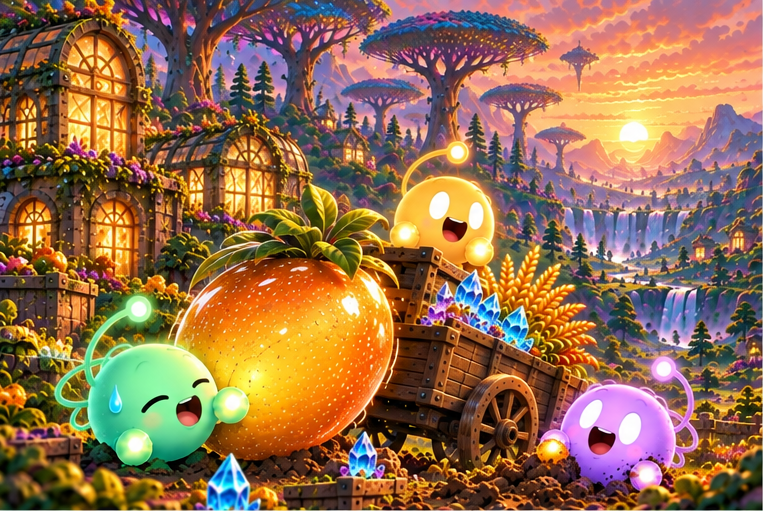
Lumins adventuring through the Nori Colony at sunset
Collect coal → break into carbon moles N deficiency causes chlorosis Liebig’s Law — the scarce resource sets the pace Saltpeter = KNO₃ → K + N Photosynthesis stores solar energy in glucose Craft NPK fertilizer from elements Frost-resistant crops make antifreeze proteins F = Gm₁m₂/r² — gravity is a well, not a line Find the Warden of Moments in the forest 6.022 × 10²³ — Avogadro’s number Collect coal → break into carbon moles N deficiency causes chlorosis Liebig’s Law — the scarce resource sets the pace Saltpeter = KNO₃ → K + N Photosynthesis stores solar energy in glucose Craft NPK fertilizer from elements Frost-resistant crops make antifreeze proteins F = Gm₁m₂/r² — gravity is a well, not a line Find the Warden of Moments in the forest 6.022 × 10²³ — Avogadro’s number
Private prototype review

Build the whole loop.
Then invite players.

The private Tideglass prototype is being used to validate one complete learning loop: navigate a living lagoon, gather evidence, make an intervention, recover from a bad model, retrieve the cause, then transfer it to a real pond.

NoticedFind three environmental clues by moving through the map.
UsedChoose an action and watch the simulated habitat respond.
ExplainedRetrieve the causal model after the immediate consequence.
TransferredApply the same relationships to a different ecosystem.

Pre-alpha demonstration. This illustrates the intended retention mechanism. It is not evidence that children retain the concept long-term; that requires delayed retrieval, unaided explanation, transfer measures, and observed playtesting.

Why use a video game at all?

Use the
format.
Change the
destination.

Games are remarkably good at sustaining attention, creating momentum, and making complicated systems feel worth mastering. This project asks whether that same format can leave players with actual, useful information about the world.

In The Nori Colony, crops die from nitrogen deficiency — real chlorosis, real turgor pressure, real limiting factors. The Molecular Scrambler breaks coal into carbon moles using real chemistry. You craft NPK fertilizer from actual elements and apply it to save your crops before winter hits on Day 60.

This is not a worksheet wearing game graphics. It is a real adventure, but the biology, chemistry, and physics are the machinery underneath it. Something you care about breaks; understanding the real system is what lets you fix it.

The success metric is not time played. It is whether someone closes the game knowing something true, notices that truth operating around them, and wants to investigate further. The game is a bridge—not the destination.

Meet the founder

I spent years
inside games.
I want that time
to lead somewhere.

Hyrum WhitmerFounder, Lumin Learning · Healthcare project manager · EEG technician · Business Administration honors graduate

I spent a large part of my childhood and teenage years playing video games. I had fun, made memories, and learned persistence. But a lot of those hours simply disappeared into the screen.

I still love games. I just wish more of them had loved my time back. I could have walked away understanding the brain, chemistry, physics, business, or the world a little better. Most of the time, I did not.

That is why I started Lumin Learning. I am not trying to turn homework into a game skin. I want games worth choosing, with knowledge built into how you survive, build, explore, and win. Kids, teens, and young adults should be able to close a game with real information still in their heads.

The goal is not more screen time. It is better time on the screens that are already there: no infinite feed, no learner advertising, and no pile of disposable content.

Parents are being asked to manage an impossible stream of games, clips, apps, and algorithmic recommendations. They should not have to play an entire game or inspect every feed before deciding whether it deserves their child's attention.

8h 15m

The typical U.S. teen spends about eight hours and fifteen minutes a day with entertainment screen media; 43% reach ten hours or more. [1]

40%

Four in ten children have a tablet by age two, and gaming time among children eight and younger rose 65% from 2020 to 2024. [2]

Up to 95%

Up to 95% of U.S. teens use social media, with more than a third reporting that they use it almost constantly. [3]

Why GTA VI belongs in this conversation

GTA VI is rated M for ages 17+ for content including intense violence, blood and gore, strong sexual content, nudity, drugs, and strong language. There is not yet a credible public estimate of how many minors are playing GTA VI, so I will not invent one. The broader issue is documented: Ofcom found children, including primary-school children, describing Grand Theft Auto and other 18+ games as familiar sources of violent content through both gameplay and clips delivered in social and video feeds. [4]

Educational games exist, especially for young children. For older learners, too many still feel like worksheets wearing costumes. Lumin Learning is my attempt to make something different. The science should change what happens in the world. Understanding should make you better at the game.
Research and ratings behind this section
  1. 2026 Common Sense Media Census: Tweens and Teens
  2. Common Sense Media: Digital Childhood Starts at Age Two
  3. U.S. Surgeon General: Social Media and Youth Mental Health
  4. Ofcom: Understanding Pathways to Online Violent Content Among Children
  5. ESRB rating summary for Grand Theft Auto VI
The loop in every world

Four acts.
Real science.

The setting changes. The science changes. The way players learn does not: explore, notice, test, then carry the idea into the real world.

01

Explore

Enter a world with a real problem worth caring about. Travel, meet characters, gather clues, and build a mental map before anyone tells you the answer.

Curiosity first
02

Observe

Notice patterns. Compare what changed and what stayed constant. The game makes evidence visible through the world—not through a detached quiz screen.

Read the system
03

Experiment

Change one variable, predict what will happen, and see the simulation respond. Wrong ideas create recoverable consequences; better models create power.

Test your model
04

Take it outside

Each world points back to something players can notice, measure, build, or investigate away from the screen—from leaves and soil to the Moon and moving objects.

Real-world transfer
Beyond the screen

The game should lead
you beyond it.

Every expedition ends by pointing outward: something real to observe, compare, sketch, measure, build, or discuss. More session time is not the goal. Useful knowledge and renewed attention to reality are.

🌿

Find the pattern in a leaf

Compare healthy and stressed leaves. Look for color, texture, symmetry, water loss, sunlight, and insect damage.

Colony field mission
🌙

Track the sky

Sketch the Moon from the same location for several nights. Predict where it will appear next and explain what changed.

Gravity field mission
🔎

Investigate a material

Choose an everyday object. Ask what properties make it useful, what it is made from, and what would happen if one property changed.

Prism field mission
What you actually learn

The science is real.

Not simplified. Not approximated. The relationships that govern the game are the same ones in your textbooks — you just encounter them as problems worth solving.

🌱

Plant Biology

Photosynthesis, chlorophyll, turgor pressure, nitrogen cycles, limiting factors, root uptake.

“My sunroot wilted — turgor pressure drops when water is low.”
⚗️

Chemistry

Molecular formulas, moles, Avogadro’s number, compound decomposition, NPK ratios.

“Saltpeter is KNO₃. One mole gives both potassium and nitrogen.”
🌍

Earth Science

Seasonal cycles, frost biology, soil composition, mineral formation, water cycles.

“Day 48 and -2°C. Frostberry can handle this. Mallow can’t.”
🧬

Genetics

Trait inheritance, selective breeding, frost-resistant gene expression, ancient seed diversity.

“These cave seeds carry antifreeze proteins older varieties lost.”
🌐

Geography

Global crop production, phosphate reserves, agricultural climate zones, food security.

“Ukraine grows 60% of world sunflower oil — now I know why a war raised prices.”
🔬

Scientific Method

Hypothesis, observation, experiment, revision. Every crop failure is data. Every fix explains itself.

“I added water but it still didn’t grow. Something else is limiting it.”
The worlds

Worlds in
development.

Each world is a distinct biome with its own science, its own mystery, and its own stakes. Knowledge from one world carries into the next.

Lumins hauling glowing crops at sunset in the Nori Colony
Private development

Nori Colony: Living Systems

Save the Nori Colony from starvation and cold before winter. Diagnose failing crops, restore the valley's plant life, and use real biology and chemistry to grow enough food and fuel to survive.

Plant biology Chemistry Earth science
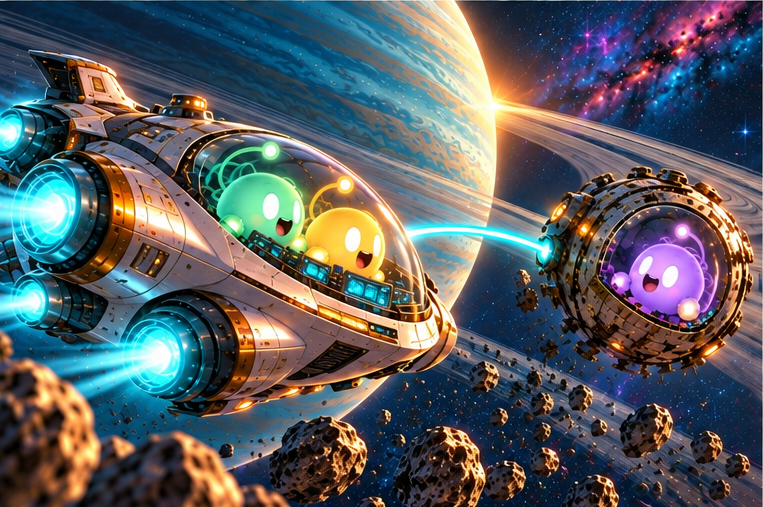
A Lumin rescue spacecraft flying past a ringed planet in deep space
Private development

Gravity Lab: Orbital Rescue

Fly a crewed rescue craft, preview mass-dependent gravity wells and trajectories, dock with stranded Lumins using real N-body motion.

Orbital mechanics Newtonian physics
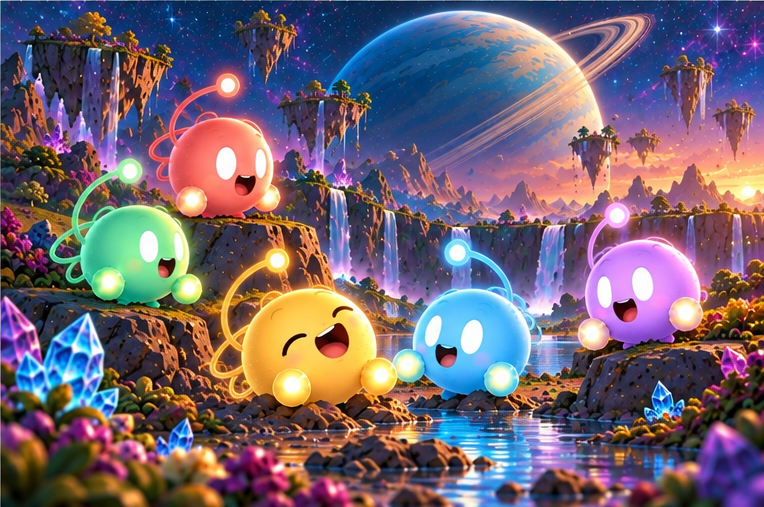
Six colorful Lumins laughing and adventuring together
Private development

Asteria Starship: Verdant Expedition

Cooperative multiplayer. Restore a failing biome by collecting the six elements living systems depend on. Scan molecular specimens and identify bonds.

Elements of life Molecular chemistry
Pre-alpha · not accepting learner pilots

Build the complete loop before asking children to test it.

Current development status

The concept and several browser prototypes exist, but the product is not yet a coherent, stable, end-to-end game. Public language now matches that reality instead of advertising access that should not be offered yet.

Working nowA short retention-mechanism demo, visual prototypes, simulations, and shared field-book experiments.
Still requiredUnified Lumin navigation, polished environment art, reliable save/state systems, onboarding, complete objectives, and recovery loops.
Test-ready gateOne complete playable expedition must pass end-to-end browser testing before supervised learner testing begins.
Evidence gateRetention claims require delayed recall, unaided explanation, transfer to a new problem, and observed behavior—not page visits or session length.
Questions

Common
questions.

Can children test the full product now?

No. Lumin Learning remains pre-alpha. The small demo above illustrates one intended learning mechanism, but the broader product still needs a complete game loop, stable persistence, coherent navigation, polished UI, and reliable failure recovery before learner testing.

Is this classroom-ready or COPPA/FERPA compliant?

No, and we will not claim otherwise. It is not a certified platform or a school deployment tool. The public demonstration requires no account and stores its small progress record only in the visitor’s browser.

What makes this different from a quiz game?

The science controls the outcome, not just the score. In The Nori Colony your crops fail from real nitrogen deficiency. Understanding Liebig’s Law is what makes you better at the game — not answering a question about it.

What does the three-minute demo measure?

It does not measure efficacy. It demonstrates the intended sequence: investigate evidence, use a model in a consequential choice, retrieve the explanation, and transfer it to a new problem. Proper measurement comes later with delayed recall and observed learner behavior.

How can educators or institutions participate?

Use the institutional partnerships page to discuss scientific review, paid discovery, supervised future pilots, or development support. No learner pilot is currently open.

Ready to make screen time count?

Follow development